Choosing a Premium Aluminum Entry Door is not just a style decision. It affects daily comfort, security, maintenance, and the first impression a building makes. In 2026, manufacturers compete through thermal-break designs, durable finishes, precise hardware, and made-to-measure options. Yet a polished product page cannot show how a door feels after years of use.
Details matter. Look closely at frame depth, corner construction, weather seals, glazing specifications, and the quality of the locking system. Ask how finishes are tested and whether replacement parts remain available. For large glazed panels, request clear information about glass performance and installation requirements. A beautiful door can disappoint if its threshold leaks or its hardware wears quickly.
Architect Louis Sullivan’s principle, “form ever follows function,” offers a useful lens for comparing manufacturers. It is not a guarantee of quality. It is a reminder to judge design alongside performance. This guide examines leading brands by product range, customization, construction details, and documented support. Some comparisons will remain imperfect: manufacturers publish different specifications, and regional service can vary. Treat rankings as a starting point, not a substitute for checking samples, warranties, and installer experience. The right choice should suit the opening, climate, and project budget—not merely the showroom.
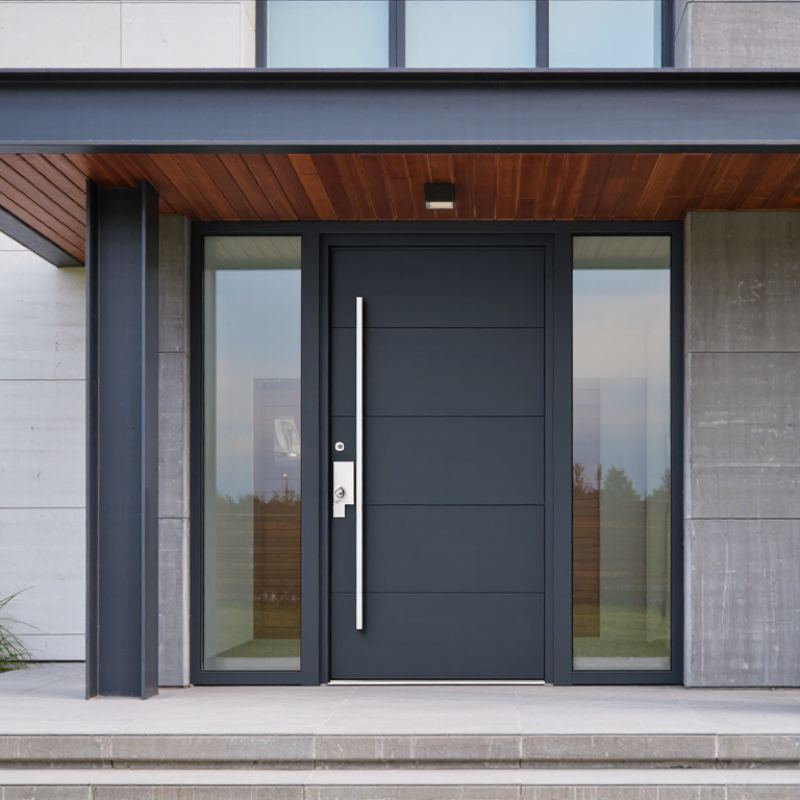
A premium aluminum entry door is more than a heavy panel with a clean finish.
It should resist wind, rain, and daily use while limiting heat transfer. Look for tested air leakage, water penetration, and structural performance under recognized fenestration standards, such as AAMA/WDMA/CSA 101/I.S.2/A440. These tests matter because a door faces pressure, weather, and repeated opening—not just a showroom inspection.
Thermal details deserve close attention. Aluminum conducts heat readily, so quality systems use thermal breaks between interior and exterior metal, plus continuous weather seals and insulated cores. The International Energy Agency’s 2024 Global Status Report for Buildings and Construction estimates that buildings account for 32% of global energy demand and 34% of energy-related emissions. A well-designed entry door cannot solve that challenge alone, but poor seals can undermine comfort near the threshold. Small gaps matter.
Ask for independently verified U-factor and air-leakage results, not vague claims such as “energy efficient.”
Check the frame corners, sill, hinges, and lock alignment; these are where installation flaws become obvious. A premium finish should also withstand scratches, moisture, and sun exposure. Still, no specification replaces careful installation. That part is easy to underestimate. A beautifully engineered door can perform poorly if its frame is out of square or the sill is not sealed continuously.
How Aluminum Entry Doors Are Designed and Manufactured
A premium aluminum entry door begins with climate, opening size, and daily use. Designers first measure wind exposure, rain direction, security needs, and thermal targets. The IEA’s Global Status Report for Buildings and Construction states that buildings consume about 30% of global final energy. This makes the door’s frame design more important than its appearance alone. Thermal breaks separate interior and exterior aluminum sections. Polyamide strips commonly reduce direct heat transfer through the frame. Designers then model sightlines, drainage paths, hinges, locks, and glass weight. A door may look minimal. Its hidden geometry is not.
Manufacturing starts with alloy profiles, precision cutting, and controlled corner joining. Fabricators machine drainage channels before assembling the frame. Gaskets must meet evenly at corners, where small gaps invite air and water. The National Fenestration Rating Council evaluates products through U-factor, solar heat gain, and air leakage measurements. These values help buyers compare tested performance instead of relying on showroom claims. Powder coating follows cleaning and surface preparation. Coating thickness, color consistency, and curing temperature require regular inspection. The weak point is often not the alloy. It is rushed fitting.
A finished door should be tested for operation, water resistance, and repeated cycling. The AAMA/WDMA/CSA 101 standard provides performance classifications for fenestration products. Still, factory data cannot replace careful site installation. That is where many good designs become disappointing. Temperature movement, uneven walls, and careless shimming remain practical risks. Manufacturers should document tolerances, test results, and maintenance requirements clearly. Credibility is built in those details.
Premium aluminum entry doors are commonly designed around standard nominal opening widths to simplify architectural coordination, extrusion design, hardware placement, and factory assembly. The dimensions shown are common residential and light-commercial nominal widths; actual finished door sizes vary by frame, threshold, and installation clearance.
Premium aluminum entry doors stand out through engineering, not just a glossy finish. Ask manufacturers for details about frame profiles, alloy grade, and thermal-break design. A thermal break separates interior and exterior metal, helping limit heat transfer. Clear specifications are more useful than broad claims about strength or efficiency.
Inspect how the door manages water and daily wear. Look for drainage paths, durable weather seals, and finishes tested for fading or corrosion. Check whether hinges, locks, and handles are rated for the door’s weight and expected use. A thick frame can still perform poorly if its corners flex or its seals leave gaps. It is easy to overvalue appearance; installation details matter just as much. Ask what measurements and site conditions the manufacturer requires.
Tips: Request test reports, finish-care instructions, and written warranty terms. Compare the same details across suppliers. If a specification is unclear, ask for a sample or drawing. Small checks can prevent expensive surprises.
| Evaluation Dimension | Premium Manufacturer Benchmark | What to Verify in Technical Documents | Why It Distinguishes Premium Products |
|---|---|---|---|
| Aluminum Alloy | Architectural-grade aluminum alloys selected for structural strength, corrosion resistance, and reliable extrusion quality. | Alloy designation, temper, extrusion standard, wall-thickness data, and material certificates. | Consistent alloy control supports accurate dimensions, long-term stability, and resistance to deformation. |
| Thermal Break | A continuous polyamide or equivalent thermal barrier separating the interior and exterior aluminum sections. | Thermal-break design drawings, frame and door U-factor, and condensation-resistance information. | Reduces conductive heat transfer and helps limit interior condensation compared with non-thermally broken frames. |
| Energy Performance | Published, independently calculated or certified whole-door thermal performance rather than glass-only data. | NFRC-rated U-factor and solar heat gain coefficient where applicable; climate-zone or local-code compliance documentation. | Whole-unit performance provides a more realistic indication of operating energy efficiency. |
| Air Infiltration | Tested weatherstripping and compression seals designed to reduce uncontrolled air leakage. | Air-leakage test method, test pressure, reported leakage rate, and applicable regional certification. | Better sealing improves comfort, reduces drafts, and helps protect the interior from dust and wind-driven moisture. |
| Water Resistance | A drained and pressure-managed sill system with replaceable seals and documented water-penetration testing. | Water-penetration test standard, pressure level, duration, sill details, and installation requirements. | Proper drainage and verified testing reduce the risk of leakage at the threshold and frame joints. |
| Structural Performance | Reinforced profiles, engineered corner connections, and load calculations matched to the opening size and site conditions. | Design pressure, deflection limits, maximum tested dimensions, and structural test reports. | Adequate structural design helps the door remain square, secure, and functional under wind and repeated use. |
| Finish Quality | Controlled powder coating or anodizing with pretreatment appropriate to the installation environment. | Finish specification, coating thickness, color tolerance, pretreatment process, and applicable AAMA or QUALICOAT documentation. | Documented finishing processes improve color consistency, adhesion, and resistance to weathering. |
| Hardware Integration | Adjustable hinges, precision latching, corrosion-resistant components, and hardware tested with the complete door assembly. | Hardware material, load rating, cycle testing, adjustment range, replacement-part availability, and security certifications. | Integrated hardware improves alignment, security, smooth operation, and long-term serviceability. |
| Glass and Glazing | Insulated, laminated, or tempered glazing options selected according to safety, climate, acoustic, and security requirements. | Glass composition, safety classification, spacer type, visible transmittance, and whole-door thermal data. | Proper glazing selection affects safety, daylight, sound control, solar gain, and overall energy performance. |
| Security Features | Multi-point locking options, reinforced strike areas, secure cylinders, and compatible access-control preparation. | Locking-point layout, cylinder standard, forced-entry test information, and compatibility with local hardware requirements. | Security is addressed as a complete door system rather than by the lockset alone. |
| Acoustic Performance | Optional acoustic glazing, tight perimeter seals, and tested assembly configurations for noise-sensitive locations. | Whole-door STC or Rw rating, test configuration, glass type, and installation conditions. | Published assembly ratings are more useful than relying on the acoustic rating of glass alone. |
| Customization Capability | Made-to-order sizes, panel layouts, sidelights, transoms, threshold options, finishes, and accessibility configurations. | Approved size limits, shop-drawing process, tolerance requirements, and engineering review for non-standard openings. | Engineered customization reduces site modifications and preserves tested performance. |
| Testing and Certification | Performance claims supported by recognized testing laboratories and standards applicable to the target market. | Current test reports, certification scope, laboratory accreditation, product configuration, and report validity. | Independent evidence separates verified performance from marketing claims. |
| Warranty and After-Sales Support | Clearly defined coverage for frame finish, hardware, glass, seals, and installation responsibilities, supported by spare parts and service guidance. | Warranty duration, exclusions, claim procedure, maintenance schedule, replacement-part lead time, and installer training. | Strong support protects the product’s lifecycle value and reduces uncertainty after installation. |
Note: Performance values should be compared only when the tested door size, glazing, hardware, installation method, and applicable regional standards are equivalent.
In 2026, leading premium aluminum entry door manufacturers distinguish themselves through tested performance, precise fabrication, and dependable installation support. A slim frame is not enough. Buyers should ask for documented air-leakage, water-penetration, and structural ratings for the complete door assembly, including its glazing and hardware. The North American AAMA/WDMA/CSA 101/I.S.2/A440 standard provides a recognized framework for evaluating fenestration products. Check that test results match the intended climate and exposure, not just a showroom sample.
Thermal details matter at the threshold. Ask how the design limits heat transfer through the frame, how the sill manages driven rain, and whether replacement seals are available. The U.S. Department of Energy’s Energy Saver guidance estimates that windows account for roughly 25–30 percent of residential heating and cooling energy use; this figure is not specific to entry doors, but it highlights why glazed components deserve scrutiny. Look for clear specifications on glass, thermal breaks, finish durability, and warranty coverage. Touch the sample. Notice the corner joints and the smoothness of the latch. A small misalignment can become irritating every day. And ratings can be confusing. Compare like with like, and ask manufacturers to explain any gaps between laboratory results and real-world installation conditions.
2026 Top Premium Aluminum Entry Door Manufacturers: How to Compare Manufacturers for Your Project?
Comparing premium aluminum door manufacturers requires more than reviewing showroom photos. Start with thermal performance, tested air leakage, water resistance, and structural performance. The U.S. Department of Energy reports that windows and doors can influence 25%–30% of residential heating and cooling energy use. Ask each manufacturer for documented U-values, solar heat gain coefficients, and test results, not broad claims such as “energy efficient.”
Material quality also deserves close inspection. Request the aluminum alloy, wall thickness, coating system, hardware grade, and drainage design. A durable finish should include clear preparation standards and measurable coating performance. The American Architectural Manufacturers Association and the Fenestration and Glazing Industry Alliance emphasize independently verified performance testing. Certification matters more than polished sales language.
Review manufacturing consistency, installation guidance, lead times, replacement procedures, and warranty exclusions. A reliable supplier should provide shop drawings and corner samples before production. Check how the door behaves after repeated opening, heavy rain, and direct afternoon sun. The sample may look perfect. Real projects are less forgiving.
Do not compare price alone. Compare tested performance per project requirement, service capacity, and evidence from completed installations. One weakness remains easy to miss: even an excellent door can fail through poor installation. Require trained installers, written tolerances, and site-specific inspection records.
Ask for test results covering air leakage, water penetration, and structural performance. Check that they apply to the complete door assembly, including glazing and hardware.
The North American AAMA/WDMA/CSA 101/I.S.2/A440 standard provides a recognized testing framework. Make sure the results match your project’s climate and exposure.
Ask about frame heat transfer, thermal breaks, glass specifications, and the sill’s rain management. A glazed door needs careful review.
Touch the finish and examine corner joints. Test the latch for smooth movement. Small misalignments can become irritating with daily use.
Request the aluminum alloy, wall thickness, coating system, hardware grade, and drainage design. A polished finish alone proves little.
Poor installation can undermine a well-made door. Ask for trained installers, written tolerances, and site-specific inspection records.
Review lead times, replacement procedures, warranty exclusions, and installation guidance. Request shop drawings and corner samples before production.
Not necessarily. Compare tested performance against your project needs, along with service capacity and evidence from completed installations. Showroom photos can mislead.
A Premium Aluminum Entry Door combines refined appearance, dependable security, durability, and energy efficiency. Its quality depends on carefully selected aluminum, sound thermal-break design, precise fabrication, and finishes suited to the building and local climate. Understanding how the door is engineered and manufactured helps buyers assess more than its appearance, including its structural strength, weather resistance, hardware, glazing options, and expected maintenance needs.
When comparing manufacturers in 2026, look beyond promotional claims and consider product testing, customization capabilities, installation support, warranty coverage, and the consistency of workmanship. The leading options are those that can clearly explain their materials and processes while offering designs that meet a project’s performance and aesthetic requirements. By comparing these factors alongside budget, lead times, and service, homeowners and project teams can choose a manufacturer with confidence.